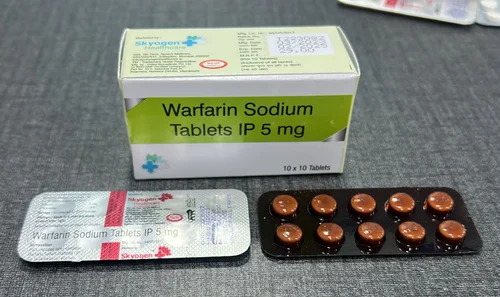
Oral Anticoagulant: Warfarin 5 mg is an oral tablet containing warfarin sodium, commonly known as a “blood thinner,” prescribed to reduce the blood’s clotting ability.
Common Strength: This 5 mg strength is one of the most frequently used dosages for both initiating therapy and as a maintenance dose, based on individual patient response.
Vitamin K Cycle Interference: It acts by interfering with the body’s vitamin K cycle, which is a crucial process for the liver to produce functional blood clotting factors.
Color-Coded Tablets: Warfarin tablets are typically color-coded by strength for easy identification and to help prevent medication errors; the specific color for 5 mg often varies by manufacturer (e.g., pink or peach in some regions).
Advantages
Effective Long-Term Prophylaxis: Highly effective for the chronic prevention and treatment of various thromboembolic conditions, providing sustained anticoagulation.
Oral Convenience: The oral tablet formulation offers significant convenience for long-term outpatient management, promoting better patient adherence compared to injectable alternatives.
Reversible Effect: Its anticoagulant effects can be quickly and effectively reversed using Vitamin K1 (Phytomenadione) or prothrombin complex concentrates (PCCs) in situations of bleeding complications or overdose.
Cost-Effectiveness & Established Use: Generally more economical than many newer direct oral anticoagulants (DOACs) and benefits from decades of extensive clinical experience, leading to well-established dosing and monitoring protocols.
Uses
Thromboembolism Prevention: Widely prescribed to prevent the formation of dangerous blood clots (thrombi) and their subsequent migration (embolism) in various high-risk patient populations.
Atrial Fibrillation (AFib): A primary indication for reducing the risk of stroke in patients with both non-valvular and valvular atrial fibrillation, where the irregular heartbeat can lead to clot formation in the heart.
Prosthetic Heart Valves: Essential for preventing clot formation on mechanical prosthetic heart valves, for which warfarin often remains the anticoagulant of choice due to its proven efficacy in this specific high-risk group.
DVT and PE Treatment/Prevention: Used for both the acute treatment and critical long-term secondary prevention of recurrence of Deep Vein Thrombosis (DVT) and Pulmonary Embolism (PE) after an initial thrombotic event.
Nature
Vitamin K Antagonist (VKA): Warfarin is classified as an indirect anticoagulant, specifically a Vitamin K Antagonist (VKA), due to its unique mechanism of action.
Inhibits VKORC1 Enzyme: It exerts its effect by competitively inhibiting Vitamin K epoxide reductase complex subunit 1 (VKORC1), a key enzyme in the liver responsible for regenerating the active (reduced) form of Vitamin K.
Impairs Clotting Factor Activation: This inhibition leads to the production of functionally inactive forms of several vital vitamin K-dependent coagulation factors: Factors II (prothrombin), VII, IX, and X, as well as the natural anticoagulant proteins Protein C and Protein S.
Delayed & Highly Variable Onset: The full therapeutic anticoagulant effect is not immediate (typically takes 2-5 days) because it depends on the depletion of pre-existing, active clotting factors. Its effect is highly variable among individuals due to genetic factors, dietary Vitamin K intake, and drug interactions, necessitating close and regular monitoring of the International Normalized Ratio (INR).
Storage
Controlled Room Temperature: Store Warfarin Tablets 5 mg at controlled room temperature, typically between 20∘C to 25∘C (68∘F to 77∘F), to maintain its stability and effectiveness.
Protection from Environment: Keep the tablets in their original, tightly closed, and child-resistant container. It is crucial to protect them from direct light, excessive heat, and especially moisture.
Avoid Humid Areas: Do not store the medication in humid environments such as bathrooms, as moisture can significantly compromise tablet stability and potency over time.
Critical Child Safety:It is absolutely paramount to keep warfarin tablets completely out of the sight and reach of children and pets due to the severe and potentially fatal risk of accidental overdose leading to life-threatening internal bleeding.