
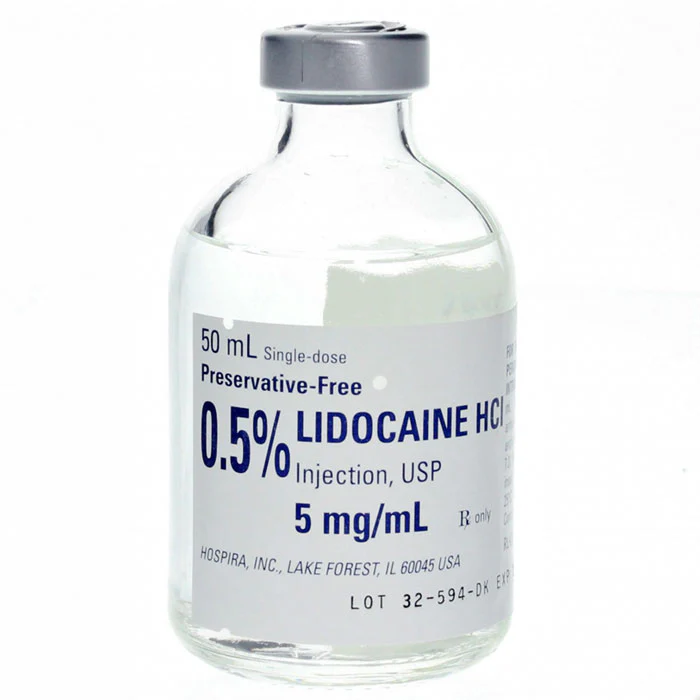
💉 Lignocaine Injection 5% with 7.5% Glucose
📘 **Description:
Lignocaine 5% with 7.5% Glucose Injection** is a hyperbaric spinal anesthetic solution used primarily for intrathecal (spinal) anesthesia. The glucose component increases the density of the solution, making it hyperbaric—which helps control the spread and duration of anesthesia within the spinal column.
🔬 Formulation:
- Active Ingredient A: Lignocaine Hydrochloride 5% (50 mg/mL)
- Additive B: Dextrose (Glucose) 7.5% w/v
- Form: Clear, sterile, non-pyrogenic solution
- Route of Administration: Intrathecal (spinal) only
- Packaging: 2 mL ampoules or vials (single-dose)
🧪 Nature / Mechanism of Action:
Lignocaine is a local anesthetic of the amide type. It blocks sodium channels in neuronal membranes, preventing impulse conduction and thus producing loss of sensation.
The glucose increases the specific gravity of the solution, making it hyperbaric—this ensures:
- Predictable spread of anesthesia
- Ability to control level of anesthesia by patient positioning
🩺 Uses / Indications:
- ✅ Spinal anesthesia for short to medium duration surgeries, including:
- Lower abdominal surgeries
- Perineal surgeries
- Urologic procedures
- Obstetric procedures (not widely used now for C-sections due to shorter duration)
Lignocaine spinal is now less commonly used due to risk of transient neurological symptoms (TNS); used mostly where short-acting spinal block is needed.
✅ Advantages:
- Rapid onset (2–5 minutes)
- Short-to-moderate duration (60–90 min of surgical anesthesia)
- Hyperbaric solution allows better control over anesthesia level
- Highly effective for quick, lower-body surgeries
- Minimal systemic absorption when used properly
⚠️ Precautions:
- Should be administered only by trained professionals under sterile conditions
- Strictly intrathecal use—not for IV/IM use
- Avoid in patients with:
- Spinal deformities
- Bleeding disorders
- Hypovolemia or shock
- Allergy to amide-type anesthetics
- Use caution in elderly and patients with cardiac conduction abnormalities
📏Typical Dosage (Adults):
- Usual dose: 1.5–2 mL (75–100 mg) injected slowly into the subarachnoid space
- Effect onset: 2–5 minutes
- Duration: 60–90 minutes of surgical anesthesia
📦 Storage:
- Store below 25°C
- Protect from light
- Single-use only; discard any unused portion
- Do not freeze