
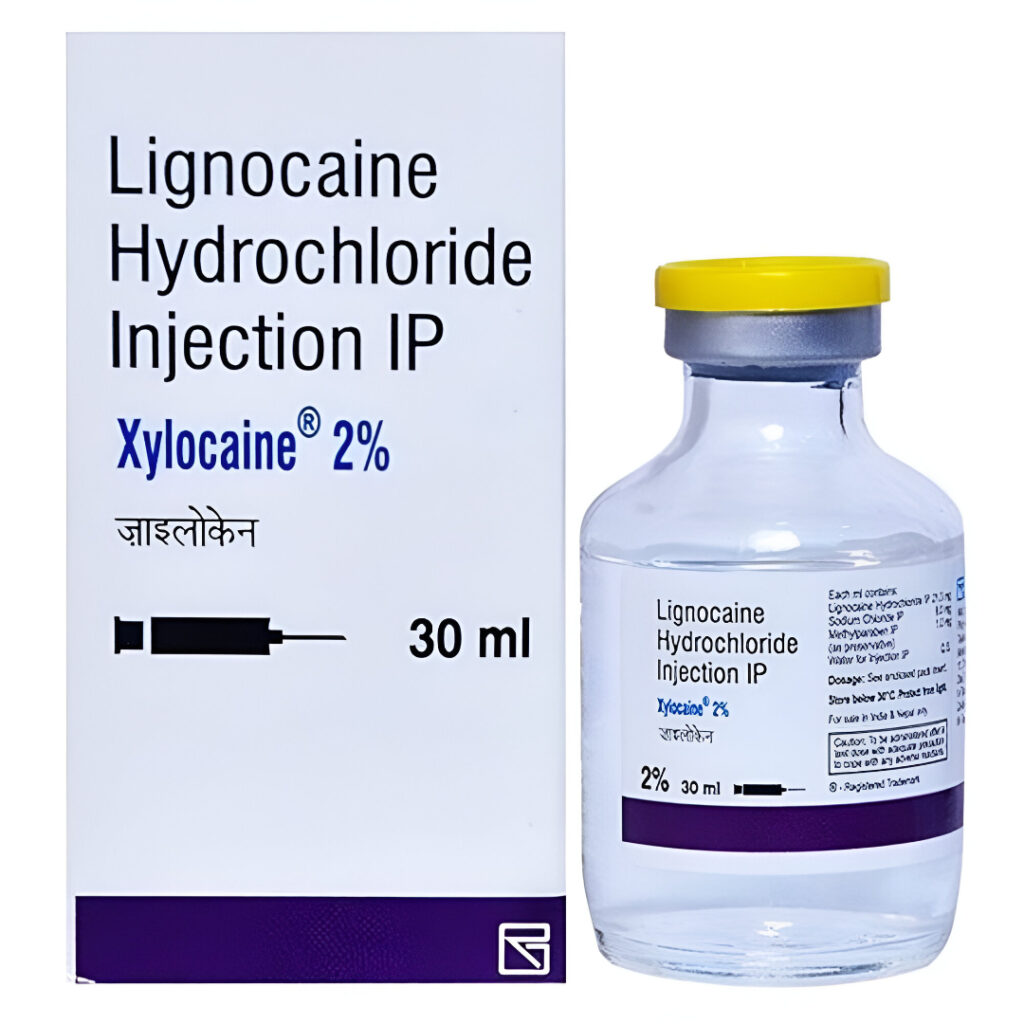
Lignocaine Injection 2% (20 mg/mL)
📘 About / Description
Lignocaine 2% Injection is a sterile, aqueous solution of lignocaine hydrochloride, used as a local or regional anesthetic. It contains 20 mg of lignocaine per mL, making it suitable for more intense or deeper anesthesia compared to the 1% formulation. It is a fast-acting amide-type anesthetic with both anesthetic and anti-arrhythmic properties.
💠 Formulation
- Concentration: 2% (20 mg/mL)
- Form: Clear, colorless solution
- Route of Administration:
- Infiltration anesthesia
- Nerve block
- Epidural / Spinal (preservative-free only)
- IV for arrhythmia (specific formulation)
- With or without adrenaline (epinephrine)
- pH: ~5.0–7.0
📝 Prescription Category
- Prescription-only (Rx)
- Use under qualified medical supervision only
💊 Uses
- Local infiltration anesthesia for minor surgery, dental, or diagnostic procedures
- Peripheral nerve blocks for regional anesthesia (e.g., limb surgeries)
- Epidural anesthesia in obstetrics or lower body surgeries
- Spinal anesthesia (only preservative-free versions)
- Intravenous regional anesthesia (Bier block)
- Antiarrhythmic use (rarely at this concentration)
🌿 Nature / Pharmacologic Profile
- Drug Class: Local anesthetic – amide type
- Mechanism of Action: Blocks voltage-gated sodium channels, stopping nerve signal conduction
- Onset: 2–5 minutes
- Duration: 1–2 hours
- Metabolism: Liver (hepatic)
✅ Advantages
- Stronger anesthetic effect than 1% lignocaine
- Quick onset, short duration – ideal for short surgical procedures
- Versatile use – suitable for dental, obstetric, orthopedic, and minor surgical applications
- Relatively safe when used correctly
- Less risk of hypersensitivity compared to ester anesthetics
⚠️ Precautions
- Max safe dosage:
- Without epinephrine: 4.5 mg/kg (max ~300 mg)
- With epinephrine: 7 mg/kg (max ~500 mg)
- Avoid intravascular injection during blocks
- Monitor for CNS and cardiovascular toxicity, especially during high-volume or IV use
- Use with caution in:
- Liver disease (impaired metabolism)
- Heart block or bradycardia
- Pregnancy or elderly patients
- Seizure disorders
🚫 Contraindications
- Hypersensitivity to amide anesthetics
- Severe hypotension or heart block (without pacemaker)
- Infected or inflamed injection site
- Severe hepatic impairment
📦 Packaging
- Glass ampoules/vials (e.g., 2 mL, 5 mL, 10 mL, 20 mL)
- Available in:
- Plain (without adrenaline)
- With adrenaline (epinephrine) for longer duration of action
- Also in preservative-free form for spinal or epidural use
🧪 Storage
- Store at 15°C–25°C (room temperature)
- Protect from light
- Use immediately after opening (single-use ampoule)
- Do not use if solution is discolored or contains particles