
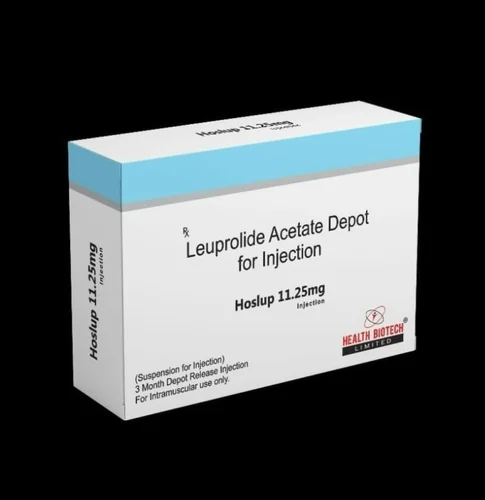
Let’s break down Leuprolide Acetate Powder for Injection 11.25 mg with a detailed description, advantages, nature, precautions, and storage specific to its use.
Leuprolide Acetate Powder for Injection 11.25 mg
1. DESCRIPTION/WHAT IS IT?
Leuprolide Acetate is a synthetic (man-made) version of a naturally occurring hormone called gonadotropin-releasing hormone (GnRH). The 11.25 mg preparation is a depot formulation, meaning it is designed to release the medication slowly and continuously into the body over an extended period. Specifically, the 11.25 mg strength is a three-month (quarterly) sustained-release injection. It comes as a sterile powder that needs to be reconstituted (mixed) with a special liquid (diluent) immediately before being injected.
2. NATURE (Pharmacology and Mechanism of Action)
- Classification: It belongs to a class of drugs called GnRH agonists.
- Mechanism of Action:
- Initial “Flare” Effect: When first administered, leuprolide acetate temporarily stimulates the pituitary gland to release a surge of luteinizing hormone (LH) and follicle-stimulating hormone (FSH). This transiently increases the levels of sex hormones (testosterone in men, estrogen in women). This is why some initial worsening of symptoms may occur.
- Desensitization and Downregulation: However, continuous exposure to leuprolide acetate desensitizes and downregulates the GnRH receptors on the pituitary gland. This constant stimulation effectively “shuts down” the pituitary’s ability to produce and release LH and FSH.
- Hormonal Suppression: As a result, the gonads (testicles in men, ovaries in women) stop producing sex hormones. This leads to a significant and sustained reduction in testosterone levels in men (to castration levels) and estrogen levels in women (to postmenopausal levels). This profound hormonal suppression is the therapeutic goal for various hormone-dependent conditions.
3. ADVANTAGES
- Convenience: A major advantage of the 11.25 mg formulation is its quarterly (3-month) dosing schedule. This means fewer injections compared to daily, weekly, or monthly formulations, improving patient convenience and adherence.
- Sustained Hormone Suppression: Provides consistent and effective suppression of sex hormones over a prolonged period.
- Effective for Hormone-Sensitive Conditions: Highly effective in managing conditions where sex hormones drive disease progression (e.g., prostate cancer, endometriosis).
- Non-Surgical Option: Offers a medical alternative to surgical castration or oophorectomy for hormone suppression.
4. PRECAUTIONS
- “Flare” Phenomenon: Patients should be aware of and prepared for a temporary worsening of symptoms during the initial few weeks of treatment due to the transient increase in hormone levels. For prostate cancer, this could mean increased bone pain or urinary difficulty. For endometriosis, increased pain.
- Bone Mineral Density (BMD) Loss: Long-term use (especially beyond 6 months for benign conditions like endometriosis or fibroids) can lead to significant bone loss and increased risk of osteoporosis and fractures. Calcium and Vitamin D supplementation and BMD monitoring (DEXA scans) are often recommended.
- Cardiovascular Risk: In men treated for prostate cancer, there is an increased risk of cardiovascular events (e.g., heart attack, stroke) and sudden cardiac death. Patients with pre-existing heart conditions or risk factors require careful monitoring.
- Metabolic Effects: May cause or worsen diabetes and dyslipidemia (abnormal cholesterol levels). Blood glucose and lipid profiles should be monitored.
- Mood Disturbances: Depression, including rare reports of suicidal ideation and attempts, can occur. Patients or caregivers should report any new or worsening mood changes.
- Seizures: Seizures have been observed; caution is advised in patients with a history of seizures or predisposing factors.
- Pseudotumor Cerebri (PTC): Rarely, increased intracranial pressure (PTC) can occur, leading to symptoms like headache, vision changes, and ringing in the ears.
- Injection Site Reactions: Common and generally mild, but can include pain, bruising, and sterile abscesses.
- Pregnancy and Lactation: Absolutely contraindicated in pregnant or breastfeeding women. It can cause fetal harm. Women of childbearing potential should use effective non-hormonal contraception during treatment and for a period after the last injection.
- Drug Interactions: Inform your doctor about all medications, supplements, and herbal products you are taking.
- Children (CPP): While used for Central Precocious Puberty, growth velocity and bone age should be monitored.
5. STORAGE
- Unreconstituted Powder: Store at room temperature (typically 20°C to 25°C or 68°F to 77°F), away from moisture and direct light. Do not freeze.
- Reconstituted Solution: Once the powder is mixed with the diluent, the suspension should be used immediately. It does not contain a preservative and should be discarded if not used within a few hours (refer to the specific product’s package insert for precise time limits, but generally, it’s very short).
- Keep out of reach of children.
- Do not store in the bathroom.