
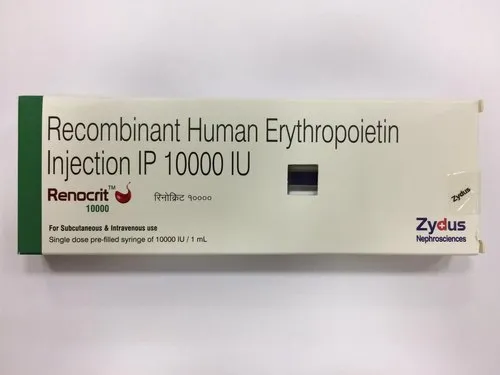
Erythropoietin Injection 10000 IU/mL: Powerful Support for Anemia Management
Description
Erythropoietin (EPO) Injection 10000 IU/mL is a sterile solution containing recombinant human erythropoietin alfa (or a similar epoetin analog). This high-concentration formulation provides a potent dose of this crucial hormone, which is naturally produced by the kidneys to stimulate red blood cell production in the bone marrow. The synthetic version is used to treat severe anemia by significantly increasing red blood cell count (erythropoiesis) in patients whose bodies cannot produce sufficient natural erythropoietin. This strength is particularly useful for individuals requiring higher or less frequent dosing for effective anemia management and can be administered intravenously (IV) or subcutaneously (SC).
Advantages
- Robust Anemia Correction: Highly effective in treating severe anemia by strongly stimulating red blood cell production, leading to a significant increase in hemoglobin and hematocrit levels.
- Reduced Transfusion Burden: Crucially minimizes or eliminates the need for frequent red blood cell transfusions, thereby lowering the risks associated with transfusions (e.g., iron overload, transfusion reactions, infections) and improving patient comfort.
- Improved Quality of Life: Alleviates debilitating symptoms of anemia such as extreme fatigue, weakness, shortness of breath, and dizziness, significantly enhancing a patient’s overall well-being and functional capacity.
- Targeted Physiological Action: Mimics the body’s natural erythropoietin, providing a specific and physiological approach to correct the underlying cause of certain anemias.
- Convenient Dosing: The higher concentration often allows for less frequent injections, which can be more convenient for patients and caregivers, especially in long-term treatment scenarios.
Uses
Erythropoietin Injection 10000 IU/mL is primarily used for the treatment of severe anemia associated with:
- Chronic Kidney Disease (CKD): A cornerstone therapy for anemia in both dialysis-dependent and non-dialysis-dependent CKD patients, where impaired kidney function leads to insufficient natural erythropoietin production.
- Chemotherapy-Induced Anemia (CIA): In adult patients with certain non-myeloid malignancies receiving myelosuppressive chemotherapy, to reduce the need for red blood cell transfusions.
- Zidovudine-Treated HIV-Infected Patients: To treat anemia specifically caused by zidovudine therapy in HIV-infected individuals.
- Reduction of Allogeneic Red Blood Cell Transfusions in Elective Surgery: Used in select high-risk adult patients undergoing elective, noncardiac, nonvascular surgery to minimize their exposure to donor blood transfusions.
- Anemia in Myelodysplastic Syndromes (MDS): Sometimes used in specific subsets of MDS patients with lower-risk disease and low endogenous erythropoietin levels.
Nature
Erythropoietin (epoetin alfa/beta) is a recombinant glycoprotein hormone that is a bioengineered replica of the natural human erythropoietin.
Its fundamental mechanism of action revolves around regulating erythropoiesis, the process of red blood cell formation:
- Binding to Erythropoietin Receptors (EPO-R): When administered, epoetin binds specifically to erythropoietin receptors (EPO-R) found on the surface of erythroid progenitor cells (immature red blood cell precursors) within the bone marrow.
- Activating Signaling Pathways: This binding triggers a series of intracellular signaling cascades, most notably the Janus kinase-signal transducer and activator of transcription (JAK2/STAT) pathway.
- Promoting Cell Proliferation, Differentiation, and Survival: The activated signaling pathways stimulate the rapid proliferation (multiplication) of these progenitor cells, their differentiation (maturation) into mature red blood cells, and enhance their survival by preventing programmed cell death (apoptosis).
- Increasing Red Blood Cell Mass: The net result is a significant increase in the production of functional red blood cells, which translates to elevated hemoglobin and hematocrit levels. This corrects the anemia and improves the blood’s oxygen-carrying capacity.
Storage
- Strict Refrigeration: Erythropoietin Injection 10000 IU/mL must be stored in a refrigerator at temperatures between 2∘C to 8∘C (36∘F to 46∘F). Maintaining this temperature range is crucial for its stability and efficacy.
- Absolutely Do Not Freeze: Freezing will irreversibly damage the product, rendering it ineffective. If the product is accidentally frozen, it must be discarded immediately.
- Protect from Light: Keep the vials or pre-filled syringes in their original carton or outer packaging to protect them from light, which can cause degradation.
- Avoid Shaking: Do not shake the product vigorously, as this can denature the protein and reduce its activity. Gentle swirling is acceptable if mixing is required after careful handling.
- Single-Dose Vial/Pre-filled Syringe: Most formulations are for single-dose use. Any unused portion should be discarded immediately after the required dose is withdrawn, as these preparations typically do not contain antimicrobial preservatives.
- Bring to Room Temperature (Briefly Before Use): If self-administering, it is generally recommended to allow the pre-filled syringe or vial to come to room temperature for about 15-30 minutes before injection to reduce injection site discomfort. However, do not leave it out of refrigeration for prolonged periods.
- Keep Out of Reach of Children: Store the medication securely, well out of the sight and reach of children and pets.
- Check Expiry Date: Always verify the expiry date printed on the packaging. Do not use the injection beyond this date. Proper disposal of expired or unused medication should follow local guidelines.