
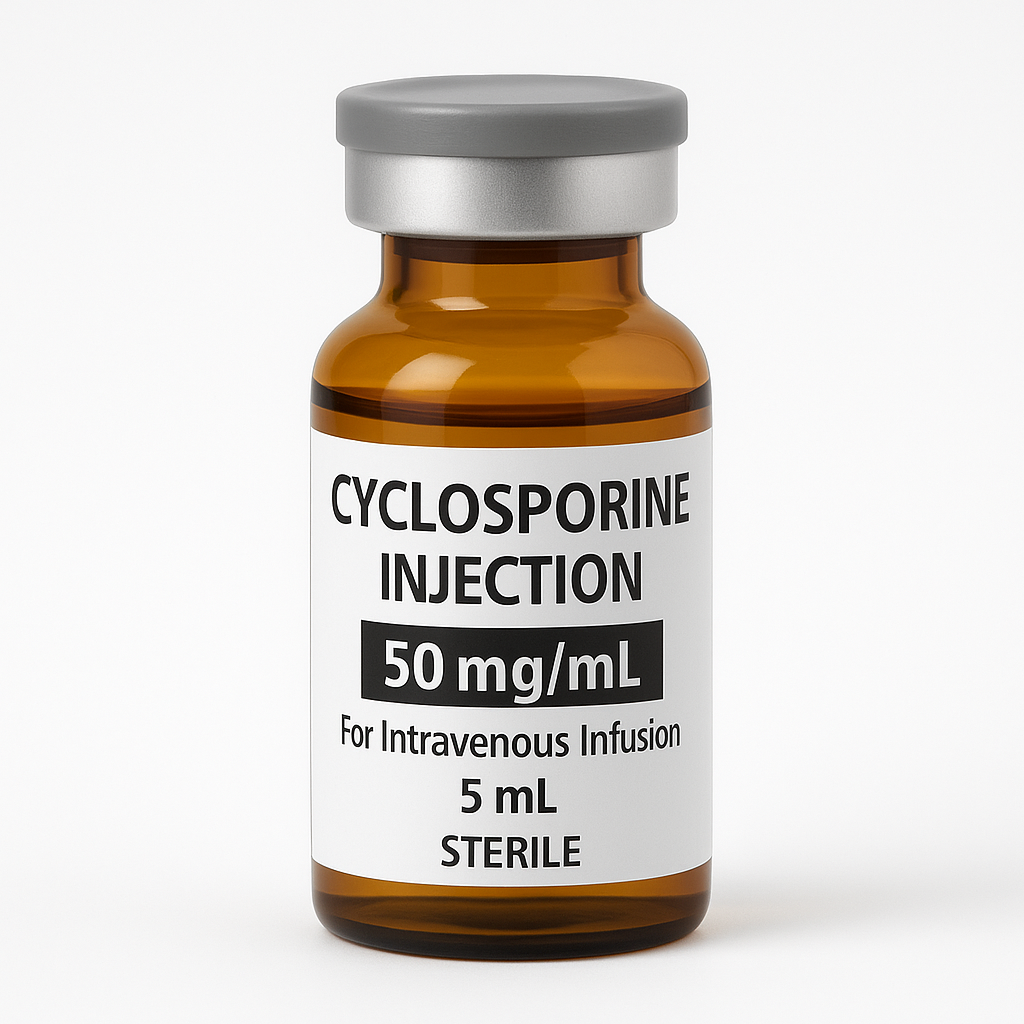
Cyclosporine Injection 50 mg/mL
1. DESCRIPTION / WHAT IS IT?
Cyclosporine Injection 50 mg/mL is a sterile solution of cyclosporine, designed for intravenous (IV) administration. The “50 mg/mL” indicates that each milliliter of the solution contains 50 milligrams of cyclosporine.1 It typically comes in ampoules or vials and is a concentrate that needs to be diluted before infusion.
This injectable form is used when patients are unable to take oral cyclosporine (e.g., immediately after surgery, during periods of severe nausea/vomiting, or when there are absorption issues). The brand name Sandimmune I.V. is a common example, representing the non-modified intravenous formulation.
It is classified as a calcineurin inhibitor, a powerful type of immunosuppressant.2
2. NATURE (Pharmacology and Mechanism of Action)
- Classification: Immunosuppressant, Calcineurin Inhibitor.3
- Mechanism of Action: Cyclosporine primarily works by selectively inhibiting the activity of T-lymphocytes, which are key cells in the immune system responsible for cell-mediated immunity (e.g., recognizing and rejecting foreign tissues, or attacking self-tissues in autoimmune diseases).4
- The core mechanism involves cyclosporine binding to an intracellular protein called cyclophilin.5
- This complex then inhibits calcineurin, an enzyme critical for activating a specific transcription factor (NF-AT).6 This transcription factor is responsible for initiating the production of various inflammatory cytokines, most notably interleukin-2 (IL-2).
- By blocking the synthesis and release of IL-2 and other related cytokines, cyclosporine effectively prevents the activation, proliferation, and differentiation of T-cells, thereby profoundly suppressing the immune response.7
- Unlike some other immunosuppressants, cyclosporine generally does not cause significant myelosuppression (bone marrow suppression) at therapeutic doses.8
3. ADVANTAGES
- Rapid Onset of Action: IV administration allows for quick achievement of therapeutic blood levels, which is crucial immediately after organ transplantation or in acute rejection episodes.
- Reliable Absorption: Bypasses the gastrointestinal tract, ensuring complete and consistent bioavailability, which can be variable with oral forms due to individual differences in absorption, food interactions, or GI issues.
- Patient Compliance in Acute Settings: Essential for patients who are unconscious, unable to swallow, or have significant gastrointestinal complications that preclude oral medication.
- Precise Dosing: Allows for very accurate administration of the required dose, which is vital for a drug with a narrow therapeutic index.
- Potent Immunosuppression: Delivers powerful immunosuppressive effects necessary for preventing organ rejection and managing severe autoimmune conditions.9
4. USES (Indications)
Cyclosporine Injection 50 mg/mL is primarily used for:
- Organ Transplant Rejection Prophylaxis: It is a cornerstone in preventing the rejection of transplanted solid organs (e.g., kidney, liver, heart, lung, pancreas).10 It is typically administered intravenously in the immediate perioperative period (just before and after surgery) until the patient can transition to an oral formulation.
- Treatment of Acute Organ Rejection: In some cases, it may be used intravenously to treat an ongoing acute rejection episode of a transplanted organ, often in combination with other anti-rejection medications.11
- Severe Autoimmune Conditions (Off-label/Specific situations): In very severe or acute flares of certain autoimmune diseases where oral administration is not possible or rapid immunosuppression is needed, the IV form might be considered (e.g., severe refractory uveitis, severe inflammatory bowel disease flare, severe aplastic anemia, though less common than its transplant indications).
5. STORAGE
- Store Cyclosporine Injection 50 mg/mL concentrate at room temperature, typically between 20°C to 25°C (68°F to 77°F).
- Keep the ampoules or vials in their original carton to protect them from light.
- Do not refrigerate or freeze the concentrate, as this can lead to precipitation or affect the formulation’s stability.
- Dilution and Stability:
- The concentrate must be diluted before infusion (e.g., with 0.9% Sodium Chloride Injection or 5% Dextrose Injection).
- Once diluted, solutions for infusion should generally be prepared fresh and used within a specific timeframe (e.g., within 24 hours), as stability can vary depending on the diluent and container.12
- Crucially, it should not be infused in PVC (polyvinyl chloride) bags as cyclosporine can leach plasticizers from PVC.13 Non-PVC containers and tubing are recommended.
- Keep out of reach of children.