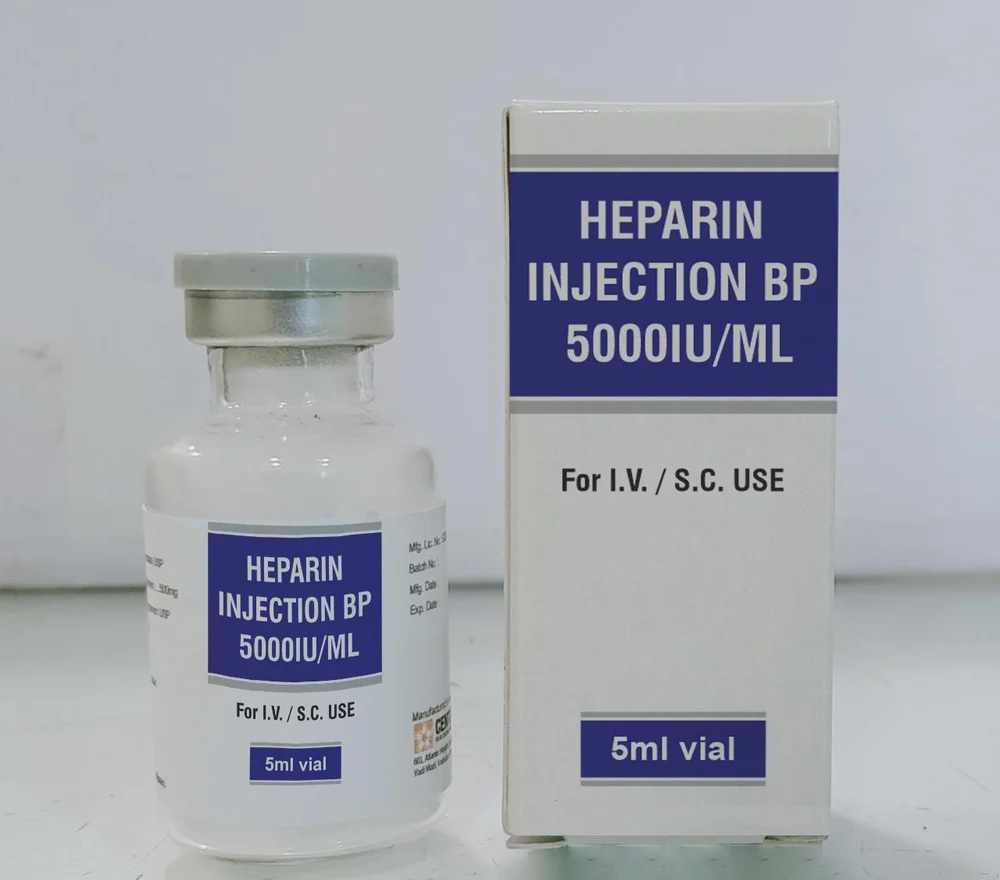
High Concentration: Heparin Injection 5000 IU/mL is a highly concentrated, sterile solution of unfractionated heparin sodium, functioning as a potent and rapidly acting anticoagulant (blood thinner).
Precise Dosage: Each milliliter of the solution delivers 5000 International Units (IU) of heparin, designed for situations requiring higher initial or maintenance doses.
Administration Versatility: It can be administered via continuous intravenous (IV) infusion, intermittent intravenous injection, or subcutaneous (SC) injection.
Natural Origin: Heparin is a naturally derived mucopolysaccharide, typically sourced from porcine intestinal mucosa.
Appearance: The solution is clear and typically colorless to pale yellow.
Advantages
Rapid and Strong Anticoagulation: Provides immediate and powerful anticoagulant effects, making it indispensable for acute, high-risk thromboembolic events.
Dose Titration: Its short half-life allows for frequent and precise dose adjustments based on activated partial thromboplastin time (aPTT) monitoring, enabling individualized therapy.
Reversible Effect: The anticoagulant action can be quickly and effectively reversed by administering protamine sulfate, which is crucial in cases of bleeding or before invasive procedures.
Broad Spectrum of Use: Effective in preventing and treating a wide range of thromboembolic conditions, including those requiring intensive anticoagulation.
Established Efficacy: Has a long history of safe and effective use in clinical practice, with extensive data supporting its role.
Uses
Treatment of Acute Thromboembolism: Primarily used for the intensive treatment of established conditions such as deep vein thrombosis (DVT), pulmonary embolism (PE), and systemic arterial embolism.
Anticoagulation in Cardiovascular Procedures: Essential for preventing clotting during procedures like open-heart surgery, percutaneous coronary intervention (PCI), and placement of catheters.
Management of Acute Coronary Syndromes (ACS): Used in conjunction with other therapies for unstable angina (UA) and myocardial infarction (MI) to prevent clot progression or reocclusion.
Extracorporeal Circulation: Provides necessary anticoagulation during hemodialysis, hemofiltration, and cardiopulmonary bypass.
Prevention of Perioperative Thrombosis: In specific high-risk surgical patients where a more aggressive prophylactic approach is warranted.
Nature
Complex Polysaccharide: Heparin is a highly sulfated linear glycosaminoglycan, carrying a strong negative charge.
Antithrombin III (ATIII) Cofactor: Its primary mechanism involves binding to and dramatically increasing the activity of antithrombin III (ATIII), a key natural inhibitor of coagulation.
Broad Coagulation Factor Inhibition: The heparin-ATIII complex then rapidly inactivates multiple coagulation factors, most importantly thrombin (Factor IIa) and Factor Xa, but also Factor IXa, XIa, and XIIa.
Inhibition Balance: Unfractionated heparin, due to its varied chain lengths, offers a relatively balanced inhibition of both Factor Xa and Factor IIa (thrombin).
No Fibrinolytic Activity: Heparin does not directly dissolve existing blood clots; rather, it prevents their enlargement and the formation of new clots, allowing the body’s intrinsic fibrinolytic system to work.
Storage
Temperature: Store Heparin Injection 5000 IU/mL at controlled room temperature, typically between 20∘C to 25∘C (68∘F to 77∘F). Avoid extreme temperatures.
Light Protection: Keep the vials or pre-filled syringes in their original carton or outer packaging to shield them from direct light, which can cause degradation.
No Freezing:Do not freeze the solution, as freezing can compromise the integrity and effectiveness of the heparin.
Multi-dose Vial Handling: If supplied in multi-dose vials, strictly adhere to the manufacturer’s instructions regarding stability after initial puncture, including discard dates (typically 28 days for preservative-containing vials).
Sterile Technique: Always use aseptic technique when preparing and administering the injection to maintain sterility and prevent contamination.
Visual Inspection: Before use, visually inspect the solution for any particulate matter, cloudiness, or discoloration. The solution should be clear and free of visible particles.