
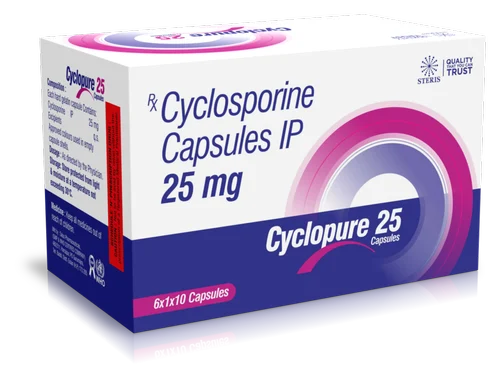
Cyclosporine Capsule 25 mg
1. DESCRIPTION / WHAT IS IT?
Cyclosporine is an oral medication containing 25 milligrams of cyclosporine. It is available in capsule form, often as a soft gelatin capsule. There are two main oral formulations of cyclosporine: modified (e.g., Neoral, Gengraf, or their generics, which form a microemulsion in water, leading to more consistent absorption) and non-modified (e.g., Sandimmune, which is oil-based and has more variable absorption). The 25 mg strength is a common dosage for starting treatment or for fine-tuning maintenance doses.
It is classified as a calcineurin inhibitor, a potent type of immunosuppressant.
2. NATURE (Pharmacology and Mechanism of Action)
- Classification: Immunosuppressant, Calcineurin Inhibitor.
- Mechanism of Action: Cyclosporine works by selectively inhibiting the activity of T-lymphocytes, which are key cells in the immune system responsible for cell-mediated immunity (e.g., organ rejection).
- It binds to a protein called cyclophilin inside immune cells.
- This complex then inhibits calcineurin, an enzyme essential for activating a transcription factor (NF-AT) that promotes the production of various inflammatory cytokines, particularly interleukin-2 (IL-2).
- By blocking IL-2 production and other related cytokines, cyclosporine prevents the activation and proliferation of T-cells, thereby suppressing the immune response.
- Unlike some other immunosuppressants, cyclosporine generally does not cause bone marrow suppression to the same extent as agents like azathioprine.
3. ADVANTAGES
- Potent Immunosuppression: Highly effective in preventing organ transplant rejection and managing severe autoimmune diseases.
- Targeted Action: Primarily targets T-cells, making it a very effective immunosuppressant with a more specific action compared to broader agents.
- Improved Transplant Outcomes: Its discovery revolutionized organ transplantation, significantly improving graft survival rates and patient outcomes.
- Oral Form: Convenient for long-term daily administration.
- Versatile: Can be used alone or, more commonly, in combination with other immunosuppressants (like corticosteroids, azathioprine, or mycophenolate mofetil).
4. USES (Indications)
Cyclosporine Capsule 25 mg is used for various conditions requiring significant immune suppression:
- Organ Transplant Rejection Prevention:
- A primary indication, used to prevent the body from rejecting transplanted organs such as kidneys, liver, heart, and pancreas. It is usually part of a multi-drug regimen.
- Autoimmune Diseases: Used for severe cases when other treatments have failed or are not tolerated:
- Severe Active Rheumatoid Arthritis: When methotrexate or other disease-modifying antirheumatic drugs (DMARDs) have been ineffective.
- Severe Psoriasis (Plaque Psoriasis): For patients with severe, recalcitrant (stubborn) plaque psoriasis who have not responded to other systemic therapies (e.g., PUVA, retinoids, methotrexate).
- Nephrotic Syndrome: Particularly for steroid-dependent or steroid-resistant cases, especially Minimal Change Disease (MCD) and Focal Segmental Glomerulosclerosis (FSGS).
- Atopic Dermatitis (Severe Eczema): For severe, chronic cases in adults that are refractory to conventional treatment.
- Other off-label uses may include severe uveitis, Crohn’s disease, and Myasthenia Gravis.
6. STORAGE
- Store Cyclosporine Capsules at room temperature (typically 20°C to 25°C or 68°F to 77°F).
- Keep them in the original blister pack or bottle to protect them from moisture, heat, and direct light.
- Some formulations may specify storing below a certain temperature or protecting from excessive humidity. Always check the specific product label.
- Keep out of reach of children.