
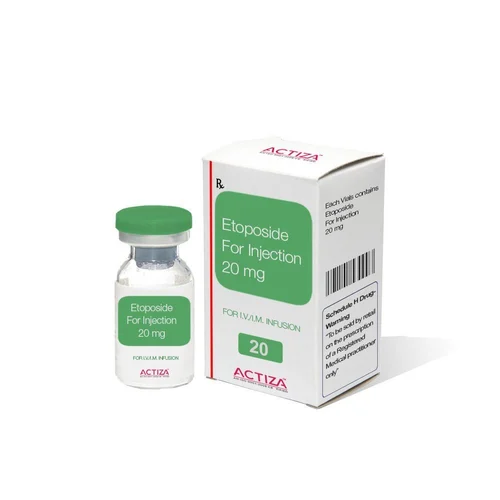
💊 Medicine Name:
Etoposide
💉 Formulation:
Injection (concentrate for solution) – for intravenous use only
💪 Strength:
20 mg/mL (commonly available in 5 mL, 10 mL, or 25 mL vials)
📜 Description:
Etoposide is a semi-synthetic derivative of podophyllotoxin, used as an antineoplastic (cytotoxic) agent. The injection is a clear, yellow to light amber solution provided as a concentrated formulation for dilution prior to IV infusion.
🌿 Nature:
- Topoisomerase II inhibitor
- Cell-cycle specific (primarily S-phase, some G2 phase activity)
- Used in combination chemotherapy protocols
- Cytotoxic and requires specialized handling
- Vesicant/irritant – infusion through a central line preferred
🌟 Advantages:
- Fast onset when IV route is required
- Preferred in cases of:
- Poor gastrointestinal absorption
- Nausea/vomiting
- Need for precise plasma concentration
- Easily combined with other IV chemotherapeutics
- Used in both curative and palliative settings
- Long history of use with well-established dosing protocols
🎯 Indications / Uses:
- Small Cell Lung Cancer (SCLC) – often with cisplatin or carboplatin
- Testicular Cancer – e.g., in BEP regimen (Bleomycin, Etoposide, Cisplatin)
- Hodgkin and Non-Hodgkin Lymphoma
- Acute Leukemias
- Neuroblastoma, Kaposi’s sarcoma, Ovarian cancer, Ewing’s sarcoma, and others
📦 Packaging:
- Glass vials containing etoposide 20 mg/mL
- Available in:
- 5 mL vial (100 mg)
- 10 mL vial (200 mg)
- 25 mL vial (500 mg)
- Labeled with cytotoxic handling warnings
- Requires dilution before administration
🧊 Storage:
- Store at controlled room temperature (15°C–25°C)
- Do not refrigerate or freeze
- Protect from light
- Use aseptic techniques for dilution
- Stable for up to 24 hours after dilution (refrigerated or at room temperature, depending on diluent)
👨⚕️ Patient Advice:
- Given only in a hospital or oncology clinic by trained professionals
- Do not self-administer or handle the drug at home
- Inform staff immediately if you feel burning, pain, or swelling during infusion
- Regular blood tests are needed to monitor white blood cells, platelets, and organ function
- May cause temporary hair loss, nausea, or mouth sores
- Use effective contraception during and for a period after treatment
- Avoid live vaccines and people with contagious illnesses during therapy
- Drink adequate fluids if advised to help with kidney elimination