
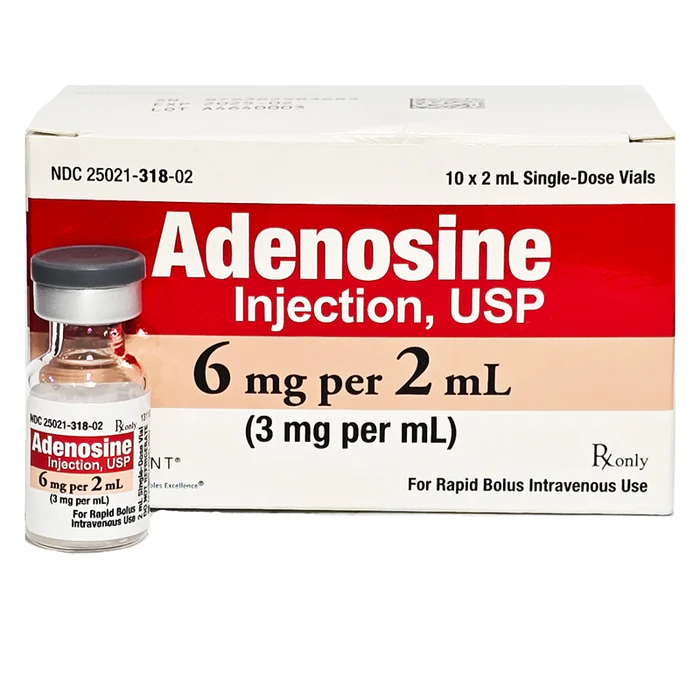
📌 Medicine Name:
Adenosine Injection 3 mg/mL
(Used as an antiarrhythmic agent)
📋 Description / Prescription:
Adenosine Injection is a rapid-acting intravenous medication used for the acute termination of paroxysmal supraventricular tachycardia (PSVT). It’s a prescription-only drug, often used in emergency or hospital settings.
- Form: Sterile, clear, colorless solution
- Strength: 3 mg per mL
- Common pack sizes: 2 mL or 5 mL ampoules/vials
- Route: IV bolus injection only
🩺 Indications:
- Paroxysmal supraventricular tachycardia (PSVT)
- Diagnostic aid in wide complex tachycardia or narrow complex tachycardia
- May help identify or unmask underlying atrial activity (e.g., flutter, fibrillation)
🔬 Nature / Mechanism of Action:
Adenosine is a naturally occurring nucleoside that works by:
- Slowing conduction through the AV node
- Interrupting reentrant circuits in AV nodal tissue
- Temporarily blocking AV node conduction, which allows restoration of sinus rhythm
🕐 Onset: 10–30 seconds
⏳ Half-life: <10 seconds (extremely short)
🧬 Acts on A1 adenosine receptors in the heart
✅ Advantages / Therapeutic Benefits:
- ✅ Rapid onset and short duration—ideal for emergency use
- ✅ Can restore normal rhythm within seconds
- ✅ Reduces need for electrical cardioversion
- ✅ Useful as a diagnostic tool in complex arrhythmias
- ✅ Generally well tolerated due to short action
📦 Packaging:
- Supplied as 3 mg/mL in:
- 2 mL ampoules (6 mg total)
- 5 mL ampoules (15 mg total)
- Single-dose ampoules or vials
- Labeled for IV use only
🌡️ Storage:
- Store at 15–25°C (59–77°F)
- Protect from light and freezing
- Use immediately after opening
- Do not refrigerate
⚠️ Precautions / Contraindications:
Contraindications:
- Second or third-degree AV block (without pacemaker)
- Sick sinus syndrome (without pacemaker)
- Asthma or severe bronchospasm
- Known hypersensitivity to adenosine
Caution in:
- Heart transplant recipients (may require lower dose)
- Seizure disorders
- Concurrent use of dipyridamole (potentiates adenosine)
- Theophylline or caffeine (reduce adenosine effect)
💉 Administration Notes (For Healthcare Providers):
- Administer as a rapid IV bolus (over 1–2 seconds)
- Follow immediately with a flush of normal saline (≥20 mL)
- Preferably via central line or large peripheral vein near the heart
- Patient should be supine, and ECG monitored continuously during administration
- Initial dose: 6 mg → if no response, 12 mg after 1–2 minutes → repeat 12 mg if needed
- Max dose: 30 mg total
👩⚕️ Patient Advice / What to Expect:
- Patients may feel brief flushing, chest pressure, breathlessness, or dizziness for a few seconds
- These effects are very short-lived (less than 1 minute)
- Should be reassured that symptoms are expected and resolve quickly
- Not for regular use—used only in acute hospital setting