
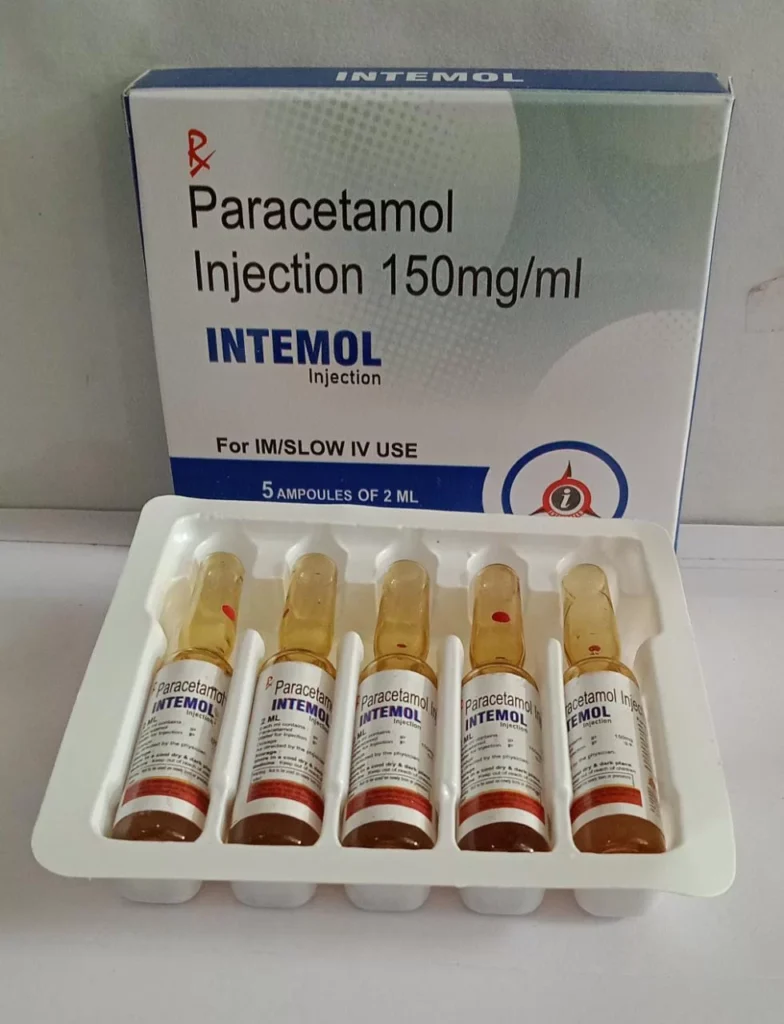
💉 Paracetamol Injection 150 mg/mL
📘 Description:
Paracetamol Injection 150 mg/mL is a clear, sterile, non-pyrogenic solution used for intravenous (IV) administration. It is intended for short-term treatment of pain and fever, especially in patients where oral or rectal routes are not feasible.
🔬 Nature / Mechanism of Action:
Paracetamol (acetaminophen):
- Acts centrally in the brain to inhibit prostaglandin synthesis
- Reduces fever by acting on the hypothalamic heat-regulating center
- Provides analgesic effect without significant anti-inflammatory action
- Has minimal effect on platelet function or gastric mucosa
🩺 Prescription / Uses:
| Indication | Use |
|---|---|
| Postoperative pain | Short-term relief after surgery |
| Acute febrile conditions | Rapid reduction of high fever |
| When oral/rectal forms unsuitable | For unconscious or vomiting patients |
| Emergency care | Pain or fever in ER/ICU |
✅ Advantages:
- Rapid onset of action (within 5–10 minutes for fever, 30 minutes for pain)
- Suitable for hospitalized, unconscious, or NPO (nothing by mouth) patients
- Avoids gastrointestinal irritation
- Good hemodynamic and renal safety profile
⚠️ Precautions:
- Strictly monitor total daily dose (risk of hepatotoxicity)
- Adjust dose in hepatic impairment
- Use with caution in renal impairment
- Avoid concomitant use with other paracetamol products
- Administer slowly over 15 minutes to avoid infusion-related reactions
🚨 Potential Side Effects:
- Common:
- Nausea
- Pain at injection site
- Rare but serious:
- Liver damage in overdose
- Hypersensitivity or allergic reaction
- Hypotension (with rapid IV push)
📏 Dosage Guidelines:
| Age Group | Typical Dose | Max Daily Dose |
|---|---|---|
| Adults & adolescents ≥50 kg | 1 g every 6 hours (max 4 g/day) | 4 g/day |
| Adults <50 kg | 15 mg/kg every 6 hours | 60 mg/kg/day (max 3 g) |
| Children >2 years | 15 mg/kg every 6 hours | 60 mg/kg/day (max 75 mg/kg/day in some cases) |
⚠️ Not recommended for children <2 years without specific pediatric formulation and dose.
💊 Drug Interactions:
- Caution with:
- Hepatotoxic drugs (isoniazid, rifampicin)
- Warfarin (may increase INR with long-term use)
- Enzyme inducers (carbamazepine, phenytoin)
📦 Storage:
💉 Paracetamol Injection 150 mg/mL
📘 Description:
Paracetamol Injection 150 mg/mL is a clear, sterile, non-pyrogenic solution used for intravenous (IV) administration. It is intended for short-term treatment of pain and fever, especially in patients where oral or rectal routes are not feasible.
🔬 Nature / Mechanism of Action:
Paracetamol (acetaminophen):
- Acts centrally in the brain to inhibit prostaglandin synthesis
- Reduces fever by acting on the hypothalamic heat-regulating center
- Provides analgesic effect without significant anti-inflammatory action
- Has minimal effect on platelet function or gastric mucosa
🩺 Prescription / Uses:
| Indication | Use |
|---|---|
| Postoperative pain | Short-term relief after surgery |
| Acute febrile conditions | Rapid reduction of high fever |
| When oral/rectal forms unsuitable | For unconscious or vomiting patients |
| Emergency care | Pain or fever in ER/ICU |
✅ Advantages:
- Rapid onset of action (within 5–10 minutes for fever, 30 minutes for pain)
- Suitable for hospitalized, unconscious, or NPO (nothing by mouth) patients
- Avoids gastrointestinal irritation
- Good hemodynamic and renal safety profile
⚠️ Precautions:
- Strictly monitor total daily dose (risk of hepatotoxicity)
- Adjust dose in hepatic impairment
- Use with caution in renal impairment
- Avoid concomitant use with other paracetamol products
- Administer slowly over 15 minutes to avoid infusion-related reactions
🚨 Potential Side Effects:
- Common:
- Nausea
- Pain at injection site
- Rare but serious:
- Liver damage in overdose
- Hypersensitivity or allergic reaction
- Hypotension (with rapid IV push)
📏 Dosage Guidelines:
| Age Group | Typical Dose | Max Daily Dose |
|---|---|---|
| Adults & adolescents ≥50 kg | 1 g every 6 hours (max 4 g/day) | 4 g/day |
| Adults <50 kg | 15 mg/kg every 6 hours | 60 mg/kg/day (max 3 g) |
| Children >2 years | 15 mg/kg every 6 hours | 60 mg/kg/day (max 75 mg/kg/day in some cases) |
⚠️ Not recommended for children <2 years without specific pediatric formulation and dose.
💊 Drug Interactions:
- Caution with:
- Hepatotoxic drugs (isoniazid, rifampicin)
- Warfarin (may increase INR with long-term use)
- Enzyme inducers (carbamazepine, phenytoin)
📦 Storage:
💉 Paracetamol Injection 150 mg/mL
📘 Description:
Paracetamol Injection 150 mg/mL is a clear, sterile, non-pyrogenic solution used for intravenous (IV) administration. It is intended for short-term treatment of pain and fever, especially in patients where oral or rectal routes are not feasible.
🔬 Nature / Mechanism of Action:
Paracetamol (acetaminophen):
- Acts centrally in the brain to inhibit prostaglandin synthesis
- Reduces fever by acting on the hypothalamic heat-regulating center
- Provides analgesic effect without significant anti-inflammatory action
- Has minimal effect on platelet function or gastric mucosa
🩺 Prescription / Uses:
| Indication | Use |
|---|---|
| Postoperative pain | Short-term relief after surgery |
| Acute febrile conditions | Rapid reduction of high fever |
| When oral/rectal forms unsuitable | For unconscious or vomiting patients |
| Emergency care | Pain or fever in ER/ICU |
✅ Advantages:
- Rapid onset of action (within 5–10 minutes for fever, 30 minutes for pain)
- Suitable for hospitalized, unconscious, or NPO (nothing by mouth) patients
- Avoids gastrointestinal irritation
- Good hemodynamic and renal safety profile
⚠️ Precautions:
- Strictly monitor total daily dose (risk of hepatotoxicity)
- Adjust dose in hepatic impairment
- Use with caution in renal impairment
- Avoid concomitant use with other paracetamol products
- Administer slowly over 15 minutes to avoid infusion-related reactions
📦 Storage:
- Store below 25°C
- Protect from light
- Do not use if solution is discolored or contains particulates
- For single use only