
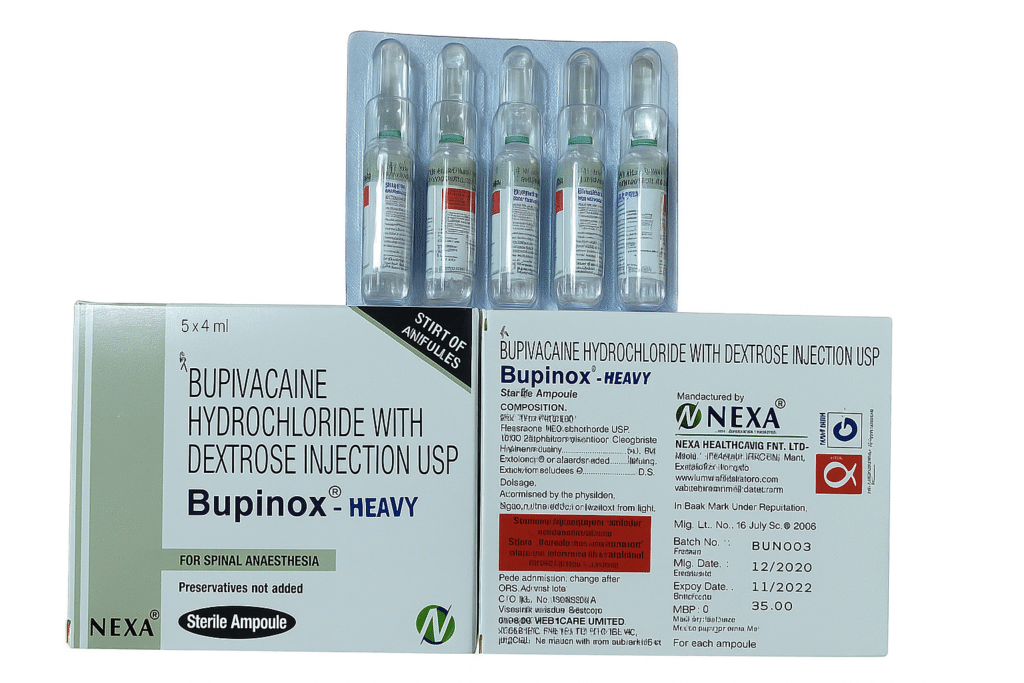
💉 Bupivacaine with Glucose Injection (Heavy Bupivacaine)
📘 Description
Bupivacaine with Glucose is a hyperbaric (heavy) spinal anesthetic solution. It contains bupivacaine hydrochloride and glucose, which increases the density of the solution, making it heavier than cerebrospinal fluid (CSF). This allows for better control of anesthesia level when injected into the subarachnoid (spinal) space.
💠 Typical Composition (per mL):
- Bupivacaine Hydrochloride: 5 mg (0.5%)
- Glucose: 80 mg (8%)
- Water for Injection: q.s.
- pH: 4.0–6.0
- Preservative: None (MUST be preservative-free for spinal use)
- Form: Clear, colorless, sterile solution
- Route: Intrathecal (Spinal Injection Only)
📝 Prescription Classification
- Schedule H Drug (Prescription only)
- Must be administered only by trained healthcare professionals in a controlled setting.
💊 Uses
- Spinal anesthesia in surgeries below the umbilicus:
- Cesarean section
- Lower limb surgery (orthopedic)
- Hernia repair
- Urological and gynecological procedures
- Short-to-moderate duration surgeries (usually under 2–3 hours)
🌿 Nature & Pharmacology
- Type: Amide local anesthetic
- Mechanism: Blocks sodium channels in nerves, preventing transmission of nerve impulses
- Hyperbaric nature: The glucose content makes it heavier than CSF, so it settles predictably in the spinal canal
- Onset: 3–5 minutes
- Duration: 1.5 to 3 hours (varies with patient and position)
✅ Advantages
- Predictable spread of anesthesia due to glucose-induced hyperbaricity
- Rapid onset and effective nerve block
- Long duration compared to lignocaine
- Minimal systemic absorption
- No preservatives – suitable for spinal administration
- Widely used in obstetrics and orthopedics
⚠️ Precautions
- Strictly for spinal (intrathecal) use only – NEVER IV
- Hypotension and bradycardia may occur – monitor BP and pulse
- Post-dural puncture headache (rare)
- Infection risk – use aseptic technique
- Contraindications:
- Hypovolemia or shock
- Severe cardiac disease
- Infection at injection site
- Coagulopathy or anticoagulant therapy
- Always have resuscitation equipment available
📦 Packaging
- Supplied in:
- 4 mL or 5 mL ampoules
- In single-dose, preservative-free form
- Labelled as “Heavy Bupivacaine” or “Bupivacaine in Dextrose”
🧪 Storage
- Store below 25°C
- Protect from light
- Do not freeze
- Discard unused portion – single-use only