
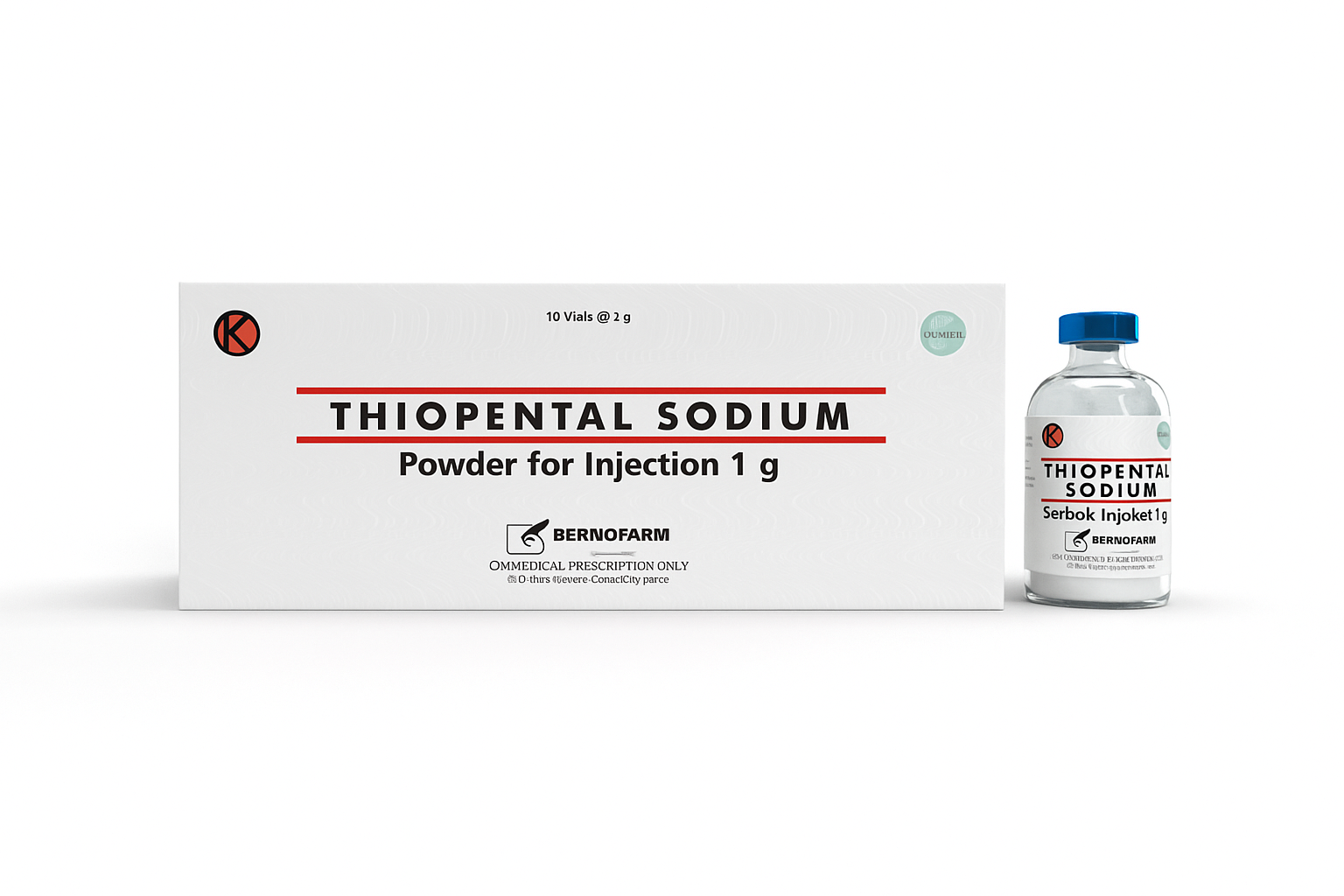
💉 Thiopentone Sodium Powder for Injection – 1 g
📝 Prescription Information
- Generic Name: Thiopentone Sodium
- Also Known As: Thiopental Sodium
- Strength: 1 gram (1000 mg) per vial
- Form: Lyophilized sterile powder for reconstitution
- Reconstitution:
- Typically reconstituted with sterile water or 0.9% saline
- Common dilution: 2.5% solution (1 g in 40 mL)
- Route: Intravenous (IV) only
- Classification: Barbiturate general anesthetic
- Regulation: Prescription-only; controlled drug in many regions
💊 Uses of Thiopentone 1 g
Thiopentone is a short-acting barbiturate primarily used for:
- Induction of general anesthesia (before inhalational or IV maintenance)
- Emergency anesthesia in trauma or rapid sequence intubation
- Treatment of status epilepticus (refractory seizures)
- Reduction of raised intracranial pressure in head trauma
- Barbiturate coma induction in neurocritical care (rare)
- ECT (Electroconvulsive Therapy) anesthesia
🌿 Nature of Thiopentone
- Appearance: Pale yellow or white sterile powder
- Solubility: Readily soluble in water; solution is strongly alkaline (pH ~10.5)
- Onset of Action: Rapid (within 20–40 seconds IV)
- Duration: 5–10 minutes of anesthesia; longer for sedation
- Distribution: Rapid brain uptake, followed by redistribution to muscle/fat
- Metabolism: Liver (hepatic); excreted via kidneys
✅ Advantages
- Fast-Acting
- Rapid induction — ideal for emergency surgeries and intubation.
- Short Duration
- Anesthetic effect wears off quickly; suitable for short procedures.
- Anti-Seizure Effect
- Controls status epilepticus when benzodiazepines fail.
- Neuroprotective
- Reduces cerebral metabolism and intracranial pressure.
- Cost-Effective
- Inexpensive and widely available, especially in low-resource settings.
- Reliable
- Long history of use in anesthesia with predictable effects.
⚠️ Precautions
- Respiratory Depression & Apnea
- Must be administered by trained personnel with airway support equipment.
- Hypotension
- Can cause significant blood pressure drop, especially in hypovolemic patients.
- Extravasation Risk
- Tissue necrosis if the alkaline solution leaks outside the vein.
- Intra-arterial Injection
- Extremely dangerous — can cause vasospasm, gangrene, or limb loss.
- Not for Continuous Use
- Accumulates in fat tissue; unsuitable for long-term sedation or maintenance.
- Contraindicated in Porphyria
- Can trigger acute attacks in porphyric patients.
- Allergy Potential
- Rare anaphylactic reactions have occurred.
- Bacterial Contamination Risk
- Use aseptic technique. Reconstituted solution must be used within manufacturer’s time limit (often 24 hours).
📦 Common Packaging
- Vial Size: 1 g (1000 mg) sterile powder
- Dilution Example: Add 40 mL sterile water to get 2.5% solution (25 mg/mL)
- Storage:
- Store powder below 25°C, dry and protected from light
- Do not freeze the reconstituted solution